01 — Fragmentation
Different frameworks, different truths
Security, economic, and governance intelligence are tracked in isolation, using different indicators and time horizons — so risks that cross domains go unseen until they collide.
Strategic Intelligence for the Horn of Africa and East Africa
HornScope brings clarity to a difficult landscape, with weighted scoring and scenario analysis that amplify the risk of the political, economic and security developments that shape the Horn of Africa and East Africa.
Pillars
Data points tracked
Analytical indicators
Scenario pathways
East Africa, Africa
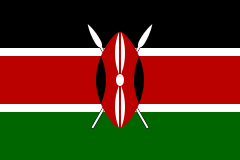
Kenya's foreign policy in 2026 is characterized by a multi-alignment strategy, engaging with various global powers without joining BRICS. The country has expanded its diplomatic footprint by establishing new relations with nations like the Solomon Islands and Jamaica, and by holding consultations with Lithuania. Operationally, Kenya has strengthened ties with the United States, focusing on trade, investment, and regional security, with plans for ...

East Africa, Africa
Madagascar's foreign relations in 2026 are characterized by active participation in regional organizations such as the African Union, the Southern African Development Community, and the Indian Ocean Commission, despite challenges like the suspension from the African Union following a 2025 coup. The Ministry of Foreign Affairs oversees the nation's diplomatic efforts, focusing on peace, regional integration, and international cooperation. Operatio...
East Africa, Africa
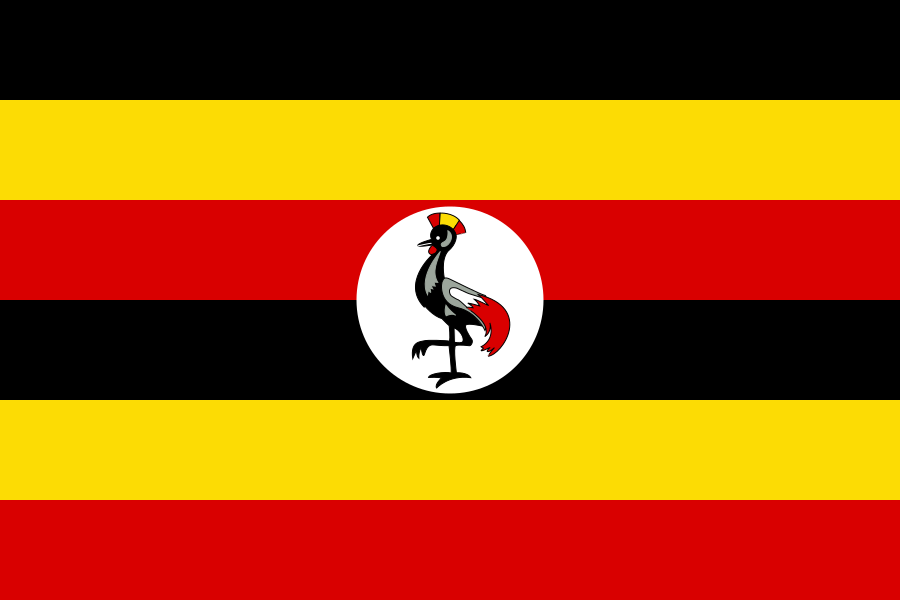
Uganda's foreign relations in 2026 are characterized by active engagement in regional and international forums, strategic bilateral partnerships, and a commitment to enhancing diplomatic capacity. The Kampala Geopolitics Conference exemplifies Uganda's role in facilitating regional dialogue on global affairs. The visit of President Félix Tshisekedi reaffirmed strong bilateral relations with the Democratic Republic of the Congo, enhancing regional...
East Africa, Africa
Uganda's macroeconomic and public finance landscape reflects a strategic shift towards full monetization of the economy, as outlined in the National Development Plan IV. The 2025/26 budget of UGX 72.4 trillion and the 2026/27 budget of UGX 84.4 trillion underscore this commitment. Operationally, the government has allocated substantial resources to sectors like agriculture, industrialization, and digital transformation. However, the rising public...
East Africa, Africa
Kenya's macroeconomic and public finance landscape in 2026 presents a complex scenario characterized by fiscal challenges and strategic policy interventions. The government's commitment to sound fiscal policy and economic recovery is evident through strategic reforms and effective public finance management. However, the rising public debt, which has surpassed the 50% GDP threshold, poses significant risks to fiscal sustainability. The government'...
East Africa, Africa
The overall assessment of Madagascar's macroeconomic framework indicates a cautious approach to fiscal and monetary policy. The government aims to reduce the budget deficit while managing public debt levels. The banking sector remains solid, but rising non-performing loans could pose risks. Inflation is projected to be a concern, and the government's strategic priorities focus on key sectors for growth. However, the political landscape remains a ...
East Africa, Africa
Kenya has made significant strides in addressing climate change and environmental challenges. In July 2026, the government launched the Integrated Natural Resources Management Programme (INReMP), a Sh34.1 billion initiative aimed at enhancing climate resilience, restoring degraded ecosystems, and improving food security for over two million Kenyans. This program focuses on climate-smart agriculture and sustainable rural development across ten cou...
East Africa, Africa
Uganda has made notable progress in climate policy and environmental conservation. The National Climate Change Regulations 2025 established the country's first national system for carbon trading, and the 2026/27 National Budget allocated substantial funds for environmental restoration and climate adaptation projects. Despite these advancements, challenges remain, including a significant decline in forest cover and threats to biodiversity from hab...
East Africa, Africa
Madagascar's environmental legal framework includes the Malagasy Environmental Charter of 2015 and the National Climate Change Action and Adaptation Program of 2006, which aim to address environmental challenges and promote sustainable development. The country has established 146 protected areas covering approximately 8.88 million hectares, reflecting a commitment to conserving its natural heritage and biodiversity. Despite these efforts, Madagas...
East Africa, Africa
Madagascar has undertaken several initiatives to bolster its humanitarian response and resilience. The government updated its National Contingency Plan and established a humanitarian hub in Manakara to facilitate rapid emergency response. The African Union Commission conducted a mission to assess the impact of Cyclone Gezani and coordinate international assistance. Operationally, the World Food Programme has been providing emergency food assistan...
East Africa, Africa
Uganda faces significant humanitarian challenges, including high levels of displacement due to conflict and climate change. The government and international organizations are actively engaged in humanitarian response efforts, but access remains uneven across regions. Vulnerable populations, particularly refugees and internally displaced persons (IDPs), require ongoing support. While there are initiatives aimed at resilience building, concerns abo...
East Africa, Africa
Kenya has implemented several structural measures to enhance its humanitarian response and resilience. Legal frameworks like the Prevention, Protection and Assistance to Internally Displaced Persons and Affected Communities Act of 2012 and the 2021 Refugees Act, along with the Shirika Plan, aim to transform refugee camps into integrated municipalities and promote self-reliance. The National Disaster Risk Management Act 2026 establishes the Nation...
East Africa, Africa
Madagascar's strategic outlook for 2026 presents a complex landscape. The government's budget law targets a 4.8% growth, focusing on agriculture, energy, infrastructure, and human development. However, the IMF projects a more cautious 3.9% growth, citing structural challenges. The African Development Bank recommends mobilizing approximately $7.27 billion annually by 2030 to finance development. The World Bank emphasizes the need for reliable ener...
East Africa, Africa
Uganda's strategic outlook for 2026 is characterized by robust economic growth, significant infrastructure development, and ambitious fiscal policies. The government projects a 10.2% economic growth rate for the 2026/2027 financial year, driven by the commencement of oil production, infrastructure development, and industrial expansion. ([firewall.parliament.go.ug](https://firewall.parliament.go.ug/index.php/news/4463/govt-targets-102-growth-musas...
East Africa, Africa
Kenya's strategic outlook for 2026 reflects a cautiously optimistic economic trajectory, supported by infrastructure development, fiscal consolidation, and climate resilience initiatives. The 2025/2026 budget prioritizes macroeconomic stability, infrastructure, and climate change mitigation. The Bottom-Up Economic Transformation Agenda guides development priorities, aiming to address persistent challenges like poverty and regional disparities. Op...
 Live Intelligence
Emerging Issues & Trends
Linking current developments to the HornScope framework — selective signals from the systems that hold societies together.
HornScope Pulse / Live
Our intelligence layer continuously surfaces emerging risks, strategic shifts, conflicts, economic pressures, and geopolitical developments across the region — providing decision-makers with an integrated view of a rapidly changing strategic environment.

Governance
A review indicates that medical cannabis may not reliably improve sleep or daytime functioning for insomnia, raising concerns about its effi
Explore
Governance
A review indicates that gifts and payments from pharmaceutical companies to clinicians may lead to harmful prescribing outcomes.
Explore
Society
A recent survey indicates a significant decline in quality of life perceptions, reflecting broader social challenges.
Explore
Security
The arrest of a Canadian cybersecurity expert linked to a hacking group raises concerns about international cybercrime implications.
Explore
Climate
The loss of glaciers highlights vulnerabilities to climate change, signaling potential impacts on water resources and ecosystems in Uganda.
Explore
Economy
The growth of Fausto's Mexican Grill highlights the economic contributions of immigrant families in the U.S.
Explore
Governance
The article discusses the political implications of using external threats to influence domestic policy and public opinion.
Explore
Governance
Research indicates gut bacteria significantly affect calorie absorption, challenging traditional food labeling and dietary assumptions.
ExploreThe Problem
Governments track security but miss economics. Investors read markets but ignore governance. Development partners treat symptoms without understanding the systems producing them. The result is a patchwork of partial insight that rarely coalesces into anything decision-makers can act on.
01 — Fragmentation
Security, economic, and governance intelligence are tracked in isolation, using different indicators and time horizons — so risks that cross domains go unseen until they collide.
02 — Reactivity
Most monitoring is event-driven. Early warning systems exist but sit disconnected from decision-making, so crises are absorbed rather than avoided.
03 — Surface diagnosis
Assessments describe protests, shocks, and violence without explaining the structures producing them — leading to intervention that treats symptoms.
Decisions made earlier, when options are wider and costs are lower.
The Architecture of Insight
Strategic Foundations, Strategic Dynamics, and Strategic Foresight are operationalized through eleven pillars — each scored on a rigorous seven-level scale, and each capable of surfacing a critical failure no average can hide.
Countries like Ethiopia, Kenya, and Djibouti play significant roles in regional influence and diplomatic relations, while nations such as Somalia and South Sudan face challenges in border diplomacy and strategic partnerships. The dynamics of great power competition and engagement with the diaspora are also crucial for the overall stability and development of these countries.
Know MoreCountries such as Somalia, South Sudan, and Sudan continue to grapple with armed conflicts and civil unrest, while others like Kenya and Uganda have made strides in improving security. The presence of organized crime and terrorism remains a concern across the region, impacting overall peace and stability.
Know MoreGovernance varies significantly across countries like Zimbabwe, Malawi, and Eritrea, with issues related to political stability, corruption, and human rights. While some nations have made progress in political participation and elections, others still face challenges in establishing effective public administration and justice systems.
Know MoreCountries such as Ethiopia, Tanzania, and Mauritius have shown economic growth, but challenges like inflation and public debt persist in others like Zimbabwe and Malawi. Effective fiscal policies and revenue mobilization are essential for sustainable economic development across the region.
Know MoreRegional trade and infrastructure development are critical for countries like Kenya, Tanzania, and Djibouti, which serve as trade hubs. However, nations such as Burundi and South Sudan face significant challenges in connectivity and logistics, impacting their economic potential.
Know MoreCountries like Uganda, Rwanda, and Mauritius have made progress in education and health, but challenges remain in poverty alleviation and gender equality across the region. Social cohesion and youth engagement are vital for sustainable development in nations like Somalia and South Sudan.
Know MoreCountries such as Madagascar, Mozambique, and Ethiopia face significant climate risks that threaten agriculture and food security. Effective management of natural resources and biodiversity is essential for sustainable development in these nations.
Know MoreCountries like Kenya and Mauritius are leading in digital transformation and innovation, while others like Burundi and South Sudan lag behind in technology adoption. Cybersecurity and digital governance are increasingly important for national competitiveness.
Know MoreThe media landscape in countries like Uganda and Kenya plays a significant role in shaping public opinion and strategic communications. However, challenges such as disinformation and hate speech are prevalent in nations like Somalia and Sudan.
Know MoreCountries such as South Sudan, Somalia, and Sudan face significant humanitarian challenges, including refugees and disaster response needs. Building social resilience and protecting vulnerable populations are critical for recovery and stability.
Know MoreCountries like Ethiopia and Kenya are increasingly focusing on risk assessment and scenario analysis to navigate emerging trends and opportunities. However, nations such as Burundi and South Sudan require improved contingency planning and institutional capacity.
Know MoreIt is a long established fact that a reader will be distracted by the readable content of a page when looking at its layout.

Commission a structured, expert-driven evaluation of a country using the HornScope framework.
Explore indices, dashboards, and comparative analytics across countries, pillars, and time.
The Scoring Framework
Every indicator is scored 0–4 against evidence-based anchors, converted to a 0–100 pillar score, and weighted by tier — so a critical breakdown in one domain surfaces clearly instead of disappearing into a comfortable average.
Not every indicator carries equal strategic weight. Critical indicators can trigger an override no strong performance elsewhere can offset.
AI–Human Hybrid Architecture
A three-stage, human-in-the-loop pipeline ensures the complete universe of evidence is considered — while final authority on every critical indicator rests with a verified human expert.
Stage 1
The AI independently searches, retrieves, and ingests publicly available sources across eight categories.
Stage 2
Experts contribute what the AI cannot autonomously discover — then the AI reconciles it against Stage 1.
Stage 3
The AI proposes a provisional score with a confidence rating; humans verify, override, and hold final authority.
Methodological Validation
HornScope holds itself to internationally recognized reliability thresholds — reviewed annually, tested against prior data, and revised whenever the evidence demands it.
Intraclass Correlation Coefficient — cross-assessor score consistency
Cohen’s Kappa — two-assessor categorical agreement
Fleiss’ Kappa — multi-expert panel agreement
Cronbach’s Alpha — internal consistency within each pillar
Every source, score, and judgment is traceable through a public audit trail.
Countries are not penalized for inherited structural deficits beyond their control.
Final interpretation always rests with a named, accountable human analyst.
HornScope functions as diagnosis, never as sanction.
National data laws and data protection standards are respected throughout.
No personal identifiers, biometric data, or surveillance feeds are ever used.
Designed For
Understand the strategic environment, identify risks and opportunities, and inform policy with a shared evidence base.
Structured assessment, early warning, and comparative analysis across a common analytical framework.
Investment risk assessment, market intelligence, and operational planning grounded in structural diagnosis.
Programming design, impact assessment, and strategic alignment across fragmented mandates.
A rigorous, validated analytical framework and structured comparative data across countries and time.
Independent assessment, advocacy grounded in evidence, and accountability through a public audit trail.
Request a Briefing
Tell us which country, sector, or decision you're navigating. A member of the Strategic Indicators team will follow up with a scoped briefing — no commitment required.
Responses are reviewed by the AI-Human Liaison team within two business days.